Monday, July 7, 2008

IT Consumerization

Thanks to Bryan Alexander and Liberal Education Today for pointing out this piece, which summarizes a phenomenon known as "IT Consumerization." The idea is that the best information technology now starts out in consumer hands and then works its way into the technology used by organizations. "Retail" or "business to consumer" hardware and software have created higher expectations for software run in an organizational setting.
The end result is that the office has gone from being the place where you spend time with cutting-edge technology, to a technological boneyard where you're perpetually trapped about three years in the past.
The piece also points out:
This phenomenon is also at work on the network, where users develop their sense of how networked apps (messaging, collaboration, and archival) should look and function through daily contact with the lively ecosystem of consumer-driven Web 2.0 applications. Next to something like Facebook or Google Maps, most corporate intranets have an almost Soviet-like air of decrepit futility, like they're someone's lame attempt to imitate for a captive audience what's available on the open market.
My observations:

Universities used to expose students to cutting edge information technologies; now the information systems with which students interact at school often seem antiquated when compared with consumer applications. For the last ten years, libraries have been fretting over their inability to provide users with an experience that is equivalent to Amazon and Google. These are just examples of the above phenomenon.

Is this lag temporary or permanent? Will the makers of enterprise software catch up? At the network level, it makes the most sense that the most advanced applications will be those that can target the broadest possible audience, and consumer applications fit that bill. Niche applications will always be at somewhat of a disadvantage due to scale.

To some extent, I think the problem is about IT departments making the "big switch" to software that can be delivered over the web. I can think of several organizationally oriented software apps that we use around here that meet the higher Web 2.0 expectations: Basecamp, Google Analytics, and Google Docs.

Another aspect of the article was the idea that employees will soon want to use their own devices (PCs and phones) at work instead of IT supplied and maintained machines. This seems like a kind of inevitable trend that may be driven by cost incentives as well as the general idea that devices like phones and laptops are highly personalized.

Monday, June 30, 2008

the publishers' views

This piece in the Chronicle about a meeting of scholarly publishers has some interesting tidbits of information in it for academic libraries.

First, it mentions a lawsuit going on between Georgia State and three publishers about fair use and electronic reserves.

Second, some university presses are now selling more titles through Amazon than to all libraries combined:

But the online bookseller also emerged as a powerful steadying force for university presses. Douglas Armato, the director of the University of Minnesota Press, shared the news that his press's sales figures through Amazon were 26 percent greater than its combined sales to libraries. Other directors and editors reported seeing similar effects. Some speculated that in an Amazon, print-on-demand world, nothing really has to stay out of print—as long as you can figure out who owns the rights.

Is this a sign that Amazon is effectively functioning as a library for some in academia, especially now that it can cover more of the out-of-print realm? Of course, our library buys some books from Amazon so I don't know if they're correcting for that.

Another interesting observation is that University Presses are no longer whining about Google digitizing their books. They finally have come around to realize that being in Google
Book Search actually is good for sales.

University presses have also, for the most part, made their peace with Google—or at least Google Book Search. Since Microsoft has dropped its competing Live Search Books program, the Google option has become "the main game in town for discovering scholarly monograph content online," as the conference program put it.

All but a handful of university presses—that is, all except no more than six, according to Chris Palma, strategic partnership development manager for Google Book Search —have signed up.

Tuesday, June 24, 2008

accessCeramics article in code4lib


An article about accessCeramics by Watzek Library's own Jeremy McWilliams' just appeared in the code4lib journal.

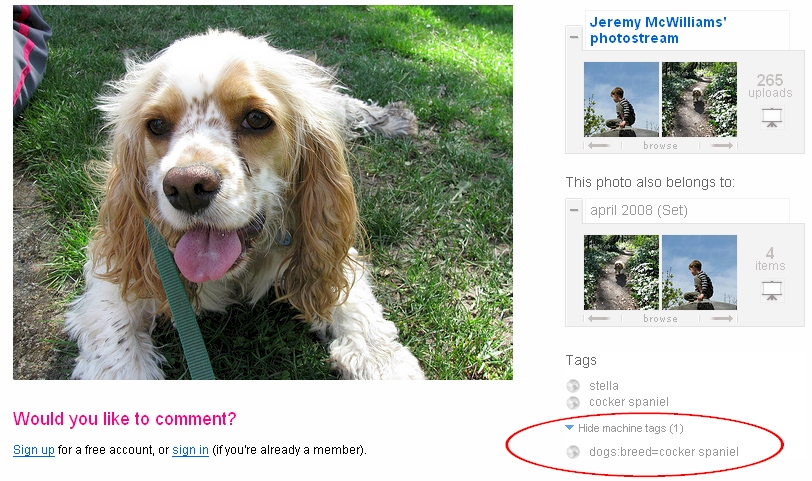
Among discussion of machine tags and the applicability of the Flickr platform to library digital collections projects, there is also a great photo of his dog, Stella, who incidentally is an amazing trail runner. I always give Jeremy a hard time about including pictures of family members in presentations and such.

I wonder if I will do such things once kid #1 arrives.

NITLE workshop on cloud computing

NITLE is hosting a workshop on cloud computing (focusing on the EC2 platform) and having a post-EDUCAUSE meeting on changes related to supporting enterprise applications
Server virtualization, software as a service, cloud computing, and open source software systems are all key technological and business factors that are dramatically changing how campuses select, deploy, and support enterprise software systems. This event will illuminate the fiscal and operational implications of these innovations for campus computing and library units. Featured presentations will include reports from campuses that have been investigating and exploiting these innovations.
It's great to see NITLE taking these issues head on. It'll be interesting to see if some colleges come up with interesting ways of using EC2. A researcher at a small college using powerful remote computers that their institution would never be able to provide is really what cloud computing is all about.

Also, its interesting that this is using a commercial entity for "cyberinfrastructure" rather than something designed specifically for academic research (though these projects could be more administrative than academic in nature).

Monday, June 23, 2008

organizing research resources with del.icio.us

The Environmental Studies program at Lewis & Clark just moved to del.icio.us as their system for developing a collection of research resources focused on local and regional/international research sites. This development relates to my recent post on the systems that they have been using up-to-now for their Mellon Research Initiative.

The move to using generic Web 2.0 applications to push forward academic projects like this one and accessCeramics is interesting. These applications aren't built for organizational use in the academy, but they are so far ahead in flexibility, usability, and Web 2.0 philosophy of what we have to use within our academic specific software realm (RefWorks, Moodle, etc.) that they become compelling.

I like del.icio.us because of its flexibility and simplicity. One library uses it to drive their research guides (explained in code4lib).

Here's the L&C Environmental Studies tag cloud so far:

Friday, June 20, 2008

web archiving as institutional repository

I like this historical tour of the University of Bath's web page, link courtesy of Lorcan Dempsey. Yet another PicLens enabled site.

As we at Watzek Library have pondered the idea of an institutional repository that would maintain an institutional record of born digital documents here at Lewis & Clark, I've often thought that it would make more sense to do wholesale web archiving of the entire Lewis & Clark web presence.

With an institution's web site acting as the defacto storage space for all sorts of documents and files, from faculty meetings, to programs for symposia, to course materials (some open, some not), an application like Archive-It (from Internet Archive) might be a lot more effective as an "institutional repository" than something like D-Space, which requires lots of time consuming user intervention to save things.

Luckily, the Internet Archive does this for us in a rudimentary sense even if we don't ask them to.

Thursday, June 19, 2008

moving into to the cloud with Google Analytics

My experience with web statistics applications provides a good example of the move to cloud computing. Back in 2001, I recall painstakingly configuring our $900 copy of WebTrends desktop app and having to remember to download log files once a month. Then in the mid-2000s, we switched to the open source Webalizer, which conveniently is web-based and resided on our Linux server. Still, there was plenty of monkeying around with log files and cron jobs to get it to record the right data.

About a year ago, I got turned onto Google Analytics. It's powerful, super easy to configure and customize. It resides in the cloud. And its "free".


The usage pattern for the Watzek Library web site goes in pretty consistent waves, with troughs as the weekend approaches and and crests as the week starts.

Every hit on our website now gets registered on a Google server. So many sites are using Analytics now, it's amazing how much traffic and data Google is digesting. With "utility" services like Analytics, they are truly making themselves part of the basic infrastructure of the Internet. Their offer to host popular Javascript libraries fits into this as well.